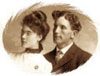
Neva Elisa Jones was born 23 January 1880, near the small town of Rodman, Iowa; during a blizzard, it is said. Her mother, Eliza, died the next day. Her mother’s death colored all of Neva’s life. In later years, Neva often talked about her mother, how she had played the violin and been a wonderful muscian; how she had died because she had contracted the measles, and that is why she died. Neva was the youngest of at least twelve children, two of whom are known to have died before Neva was born. The two oldest living children, both boys, had already left home.
Neva’s father, George Jones, had had trouble supporting his family before his wife died. With Eliza gone, caring for a large family was beyond him. He found people to care for the youngest children: Lottie, three years old and Neva’s closest sister, was taken by friends of Eliza’s into an already a blended family; Ona, five and next youngest, was taken in by an older couple who lived in neighboring Dickinson County; Reuben, six, eventually found a home with a near-by farmer. Likely Edward (ten) and Henry (twelve), also found homes with farmers either in Palo Alto or neighboring counties. Frank, at fourteen, was probably considered old enough for a full-time job. Anna, at fifteen the oldest still at home, apparently assumed responsibility for Neva, along with becoming a school teacher. Anna had help from her mother’s sister, Charlotte Bliss, whose family moved to Palo Alto about this time, providing a place for Anna and Neva to live.
In spite of their separation, Neva’s brother’s and sisters made an effort to stay in touch with each other, visiting when they could, writing when they couldn’t. Reuben, for example, had an autograph book, which he treasured for his entire life. It was signed by his brothers Dell and Stephen in 1895, his brother Henry in 1896, and his sisters Neva and Anna in 1901. Their father did return home at least once, but the visit was not remembered with any fondness by his children. Part of his reason for visiting was an effort to find financial assistance, at their expense if need be.
By 1900, when Neva was twelve, she, Anna, and Henry were living near Milford, in neighboring Dickinson County, where Henry farmed. Likely their brother Edward, newly married and living nearby, had lived with them for a time, as well. Many of Neva’s childhood memories seemed to center on her time around Milford. All her life she kept a cookbook published by the Ladies Aid Society of the Milford Methodist Church, along with other mementos of the area.[20] It is likely here, as well, that Neva and a friend worked for the Chautauqua, one of the highlights of her youth. Then Anna became ill, bed-ridden with tuberculosis. Her only hope of survival, she was told, was to move immediately to Colorado. By 1907, when Neva was nineteen, Anna was living in Denver and Neva was teaching school in Kenmare, Ward County, North Dakota.[19]
At the time of Anna’s illness, three of Neva’s brothers had moved to North Dakota, presumably seeking land. Henry was in Wahpetan, in southeastern North Dakota, by 1902, accompanied or followed soon after by his brother Edward. Reuben, their younger brother, moved further north and west, arriving in Tioga, North Dakota in June of 1903. About three years later, he applied for a homestead grant, and received the patent in 1909 for land in Montrail County.
As for Neva’s other brothers, Frank, who had been fourteen when their mother died, was working as a coal miner in southern Iowa when he enlisted in the army in 1898 for the Spanish-American War. He probably felt that life in the army would be better than work in a coal mine. He did write home about life in boot camp, but like so many others, he never had an opportunity to experience the “glory” of war. Within three months of enlisting, still in boot camp, he died of typhoid fever.
Stephen, the next to oldest brother, away from home when their mother died, remained in Iowa, where he, too, died young. He was run over by a train in a snowstorm, leaving a pregnant widow and two young children, who stayed in Iowa where her family was. Dell, the oldest of the brothers and also away from home when their mother died, married in Iowa twice, both wives dying young. He eventually moved to Wyoming.
Neva’s other sisters, Ona and Lottie, both married, and both remained in contact with other family members, but they were not part of the initial North Dakota migration.
Neva apparently went with her brother Henry to North Dakota, or perhaps joined him there. Like other single young women, she found work as a school teacher, and like many young school teachers at the time, her own education may not have been more than a few steps ahead of her students. Certainly, in later years, neither her handwriting nor her spelling would have been seen as models to emulate, and she herself was a strong advocate for education, feeling that her own was sadly lacking.
Being a young woman more or less on her own apparently didn’t worry Neva, though. It is said that she carried a pearl-handled derringer, and loved to ride, often seen racing the wind across the prairies, her long hair streaming behind her. And it was through her work as a teacher that Neva met her future husband, George Knott.
Marriage and Motherhood
Neva and George were married on 17 March 1909 in Wyndmere, North Dakota, where her brother Henry lived. How they met is unclear, but most likely when Neva was in Kenmare, Ward County, North Dakota.[19] Neva and George spent the first years of their married lives in a sod house on George’s homestead near Powers Lake, North Dakota. In later years Neva had few good things to say about life in a sod house. Even with sheets up on the walls and ceilings, she said, there was always dirt, and it was impossible to keep the house clean. It did have one advantage: when one of her young sons had a temper tantrum, she simply poured a pitcher of water over him, knowing that the floor would dry by itself. Her subdued son was set on a rock in the yard to dry in the sun.
Neva’s approach to child rearing was practical. Farm wives were busy, their work an essential part of the family’s economy. Neva knew many ways of ensuring her boys were safe while she worked. A baby in a highchair would be given a feather after having his hands dabbed with molasses; a crawling child could be tethered to a table leg with a soft rope of rags to keep him out of danger.
Not her all strategies worked as intended. Once, when her youngest son was still in diapers, she put him in a rabbit hutch so that she could hoe the garden. After some time, she heard a loud scream and went running, fearing the rabbit had bitten her son. Instead, it was the rabbit screaming – her son had used a diaper pin to stick the rabbit’s ears together. Another time, when the boys were older, all in school, they had left their clothes strewn around the bedroom rather than hanging them up. So Neva threw them out the window, for the boys to retrieve when they came home. But it started to rain, and Neva had to bring the clothes in herself.
Marriage and motherhood did not automatically turn the derringer-carrying young woman into a sedate matron. Soon after her marriage, a friend was coming to visit. Neva’s husband, George, had a mustache, of which he was inordinately proud. Neva didn’t like it. The night before her friend was to arrive, Neva managed to shave off half the mustache while George slept, assuming that he would shave the other half the next morning. But they overselpt, and George dashed out of the house without looking in a mirror, drove to Minot and returned with Neva’s friend, all with half a mustache. After moving to Washington, Neva had a dog, a collie, “before they became over-bred”, a dog intensely loyal to her. At least one summer night she and the dog and her sons, “camped out”, sleeping outdoors. Another time, angry with her husband, she sicced the dog on him and had him dancing on the kitchen table.
Although not outspoken, Neva had opinions on many subjects. She believed strongly in family – and whatever her personal feelings towards an individual, if they were family, they were welcomed. Similarly, she usually felt that consideration and politeness were owed to most people she met. Except, perhaps, her father. And except her husband’s Uncle Charlie, who she felt was a scoundrel, and would not hear a good word said about him. She refused to refer to the cattle ranch where she and her husband lived after losing their homestead as a ranch – it was a stock farm, she insisted, and the men who worked there were not cowboys, they were hands. There were other subjects she negotiated by maintaining silence – having to work out of the home during the Depression, and the illness of one of her sons that led to the loss of the North Dakota homestead, for example. And she didn’t like mountains, in spite of having lived most of her adult life surrounded by them. They cut off the view, she explained.
Later Years
When Neva’s husband retired, they moved from their farm to a home in Sedro Woolley, one that had electricity. Throughout her married life, from the sod house in North Dakota to the log house “up the hill“ from Clear Lake, Washington and it’s eventual replacement with a frame house, Neva had lived with kerosene lamps, wood cook stoves, and flat irons heated on the wood stove for ironing. Electricity was something she appreciated, so much so that when their farm house did receive electricity, she had to visit just so she could go from room to room flicking the switches.
One of the attractions of Sedro Woolley, other than electricity, was the nearness of her son Gordon and his family. When Gordon moved to Kennewick, Neva and George followed, and then again to Walla Walla. By then George was crippled with rheumatism in his knees and suffering from Parkinson’s disease, for which there was no known treatment. Neva turned to charismatic Christian preachers for a cure, but to no avail. George died in January 1962. For a brief time in the latter half of the 1960s, Neva lived in Olympia Washington, near her youngest son Norman and his new family, but returned to Kennewick when Norman moved out of the country. There, with increasing senile dementia and Gordon as her caregiver, she turned to her Bible for solace, passing away on 3 May 1985. She is buried next to her husband George. There are no mountains to obscure her view.
Neva Elisa Jones was born 23 January 1880, near the small town of Rodman, Iowa; during a blizzard, it is said. Her mother, Eliza, died the next day. Her mother’s death colored all of Neva’s life. In later years, Neva often talked about her mother, how she had played the violin and been a wonderful muscian; how she had died because she had contracted the measles, and that is why she died. Neva was the youngest of at least twelve children, two of whom are known to have died before Neva was born. The two oldest living children, both boys, had already left home.
Neva’s father, George Jones, had had trouble supporting his family before his wife died. With Eliza gone, caring for a large family was beyond him. He found people to care for the youngest children: Lottie, three years old and Neva’s closest sister, was taken by friends of Eliza’s into an already a blended family; Ona, five and next youngest, was taken in by an older couple who lived in neighboring Dickinson County; Reuben, six, eventually found a home with a near-by farmer. Likely Edward (ten) and Henry (twelve), also found homes with farmers either in Palo Alto or neighboring counties. Frank, at fourteen, was probably considered old enough for a full-time job. Anna, at fifteen the oldest still at home, apparently assumed responsibility for Neva, along with becoming a school teacher. Anna had help from her mother’s sister, Charlotte Bliss, whose family moved to Palo Alto about this time, providing a place for Anna and Neva to live.
In spite of their separation, Neva’s brother’s and sisters made an effort to stay in touch with each other, visiting when they could, writing when they couldn’t. Reuben, for example, had an autograph book, which he treasured for his entire life. It was signed by his brothers Dell and Stephen in 1895, his brother Henry in 1896, and his sisters Neva and Anna in 1901. Their father did return home at least once, but the visit was not remembered with any fondness by his children. Part of his reason for visiting was an effort to find financial assistance, at their expense if need be.
By 1900, when Neva was twelve, she, Anna, and Henry were living near Milford, in neighboring Dickinson County, where Henry farmed. Likely their brother Edward, newly married and living nearby, had lived with them for a time, as well. Many of Neva’s childhood memories seemed to center on her time around Milford. All her life she kept a cookbook published by the Ladies Aid Society of the Milford Methodist Church, along with other mementos of the area.[20] It is likely here, as well, that Neva and a friend worked for the Chautauqua, one of the highlights of her youth. Then Anna became ill, bed-ridden with tuberculosis. Her only hope of survival, she was told, was to move immediately to Colorado. By 1907, when Neva was nineteen, Anna was living in Denver and Neva was teaching school in Kenmare, Ward County, North Dakota.[19]
At the time of Anna’s illness, three of Neva’s brothers had moved to North Dakota, presumably seeking land. Henry was in Wahpetan, in southeastern North Dakota, by 1902, accompanied or followed soon after by his brother Edward. Reuben, their younger brother, moved further north and west, arriving in Tioga, North Dakota in June of 1903. About three years later, he applied for a homestead grant, and received the patent in 1909 for land in Montrail County.
As for Neva’s other brothers, Frank, who had been fourteen when their mother died, was working as a coal miner in southern Iowa when he enlisted in the army in 1898 for the Spanish-American War. He probably felt that life in the army would be better than work in a coal mine. He did write home about life in boot camp, but like so many others, he never had an opportunity to experience the “glory” of war. Within three months of enlisting, still in boot camp, he died of typhoid fever.
Stephen, the next to oldest brother, away from home when their mother died, remained in Iowa, where he, too, died young. He was run over by a train in a snowstorm, leaving a pregnant widow and two young children, who stayed in Iowa where her family was. Dell, the oldest of the brothers and also away from home when their mother died, married in Iowa twice, both wives dying young. He eventually moved to Wyoming.
Neva’s other sisters, Ona and Lottie, both married, and both remained in contact with other family members, but they were not part of the initial North Dakota migration.
Neva apparently went with her brother Henry to North Dakota, or perhaps joined him there. Like other single young women, she found work as a school teacher, and like many young school teachers at the time, her own education may not have been more than a few steps ahead of her students. Certainly, in later years, neither her handwriting nor her spelling would have been seen as models to emulate, and she herself was a strong advocate for education, feeling that her own was sadly lacking.
Being a young woman more or less on her own apparently didn’t worry Neva, though. It is said that she carried a pearl-handled derringer, and loved to ride, often seen racing the wind across the prairies, her long hair streaming behind her. And it was through her work as a teacher that Neva met her future husband, George Knott.
Marriage and Motherhood
Neva and George were married on 17 March 1909 in Wyndmere, North Dakota, where her brother Henry lived. How they met is unclear, but most likely when Neva was in Kenmare, Ward County, North Dakota.[19] Neva and George spent the first years of their married lives in a sod house on George’s homestead near Powers Lake, North Dakota. In later years Neva had few good things to say about life in a sod house. Even with sheets up on the walls and ceilings, she said, there was always dirt, and it was impossible to keep the house clean. It did have one advantage: when one of her young sons had a temper tantrum, she simply poured a pitcher of water over him, knowing that the floor would dry by itself. Her subdued son was set on a rock in the yard to dry in the sun.
Neva’s approach to child rearing was practical. Farm wives were busy, their work an essential part of the family’s economy. Neva knew many ways of ensuring her boys were safe while she worked. A baby in a highchair would be given a feather after having his hands dabbed with molasses; a crawling child could be tethered to a table leg with a soft rope of rags to keep him out of danger.
Not her all strategies worked as intended. Once, when her youngest son was still in diapers, she put him in a rabbit hutch so that she could hoe the garden. After some time, she heard a loud scream and went running, fearing the rabbit had bitten her son. Instead, it was the rabbit screaming – her son had used a diaper pin to stick the rabbit’s ears together. Another time, when the boys were older, all in school, they had left their clothes strewn around the bedroom rather than hanging them up. So Neva threw them out the window, for the boys to retrieve when they came home. But it started to rain, and Neva had to bring the clothes in herself.
Marriage and motherhood did not automatically turn the derringer-carrying young woman into a sedate matron. Soon after her marriage, a friend was coming to visit. Neva’s husband, George, had a mustache, of which he was inordinately proud. Neva didn’t like it. The night before her friend was to arrive, Neva managed to shave off half the mustache while George slept, assuming that he would shave the other half the next morning. But they overselpt, and George dashed out of the house without looking in a mirror, drove to Minot and returned with Neva’s friend, all with half a mustache. After moving to Washington, Neva had a dog, a collie, “before they became over-bred”, a dog intensely loyal to her. At least one summer night she and the dog and her sons, “camped out”, sleeping outdoors. Another time, angry with her husband, she sicced the dog on him and had him dancing on the kitchen table.
Although not outspoken, Neva had opinions on many subjects. She believed strongly in family – and whatever her personal feelings towards an individual, if they were family, they were welcomed. Similarly, she usually felt that consideration and politeness were owed to most people she met. Except, perhaps, her father. And except her husband’s Uncle Charlie, who she felt was a scoundrel, and would not hear a good word said about him. She refused to refer to the cattle ranch where she and her husband lived after losing their homestead as a ranch – it was a stock farm, she insisted, and the men who worked there were not cowboys, they were hands. There were other subjects she negotiated by maintaining silence – having to work out of the home during the Depression, and the illness of one of her sons that led to the loss of the North Dakota homestead, for example. And she didn’t like mountains, in spite of having lived most of her adult life surrounded by them. They cut off the view, she explained.
Later Years
When Neva’s husband retired, they moved from their farm to a home in Sedro Woolley, one that had electricity. Throughout her married life, from the sod house in North Dakota to the log house “up the hill“ from Clear Lake, Washington and it’s eventual replacement with a frame house, Neva had lived with kerosene lamps, wood cook stoves, and flat irons heated on the wood stove for ironing. Electricity was something she appreciated, so much so that when their farm house did receive electricity, she had to visit just so she could go from room to room flicking the switches.
One of the attractions of Sedro Woolley, other than electricity, was the nearness of her son Gordon and his family. When Gordon moved to Kennewick, Neva and George followed, and then again to Walla Walla. By then George was crippled with rheumatism in his knees and suffering from Parkinson’s disease, for which there was no known treatment. Neva turned to charismatic Christian preachers for a cure, but to no avail. George died in January 1962. For a brief time in the latter half of the 1960s, Neva lived in Olympia Washington, near her youngest son Norman and his new family, but returned to Kennewick when Norman moved out of the country. There, with increasing senile dementia and Gordon as her caregiver, she turned to her Bible for solace, passing away on 3 May 1985. She is buried next to her husband George. There are no mountains to obscure her view.